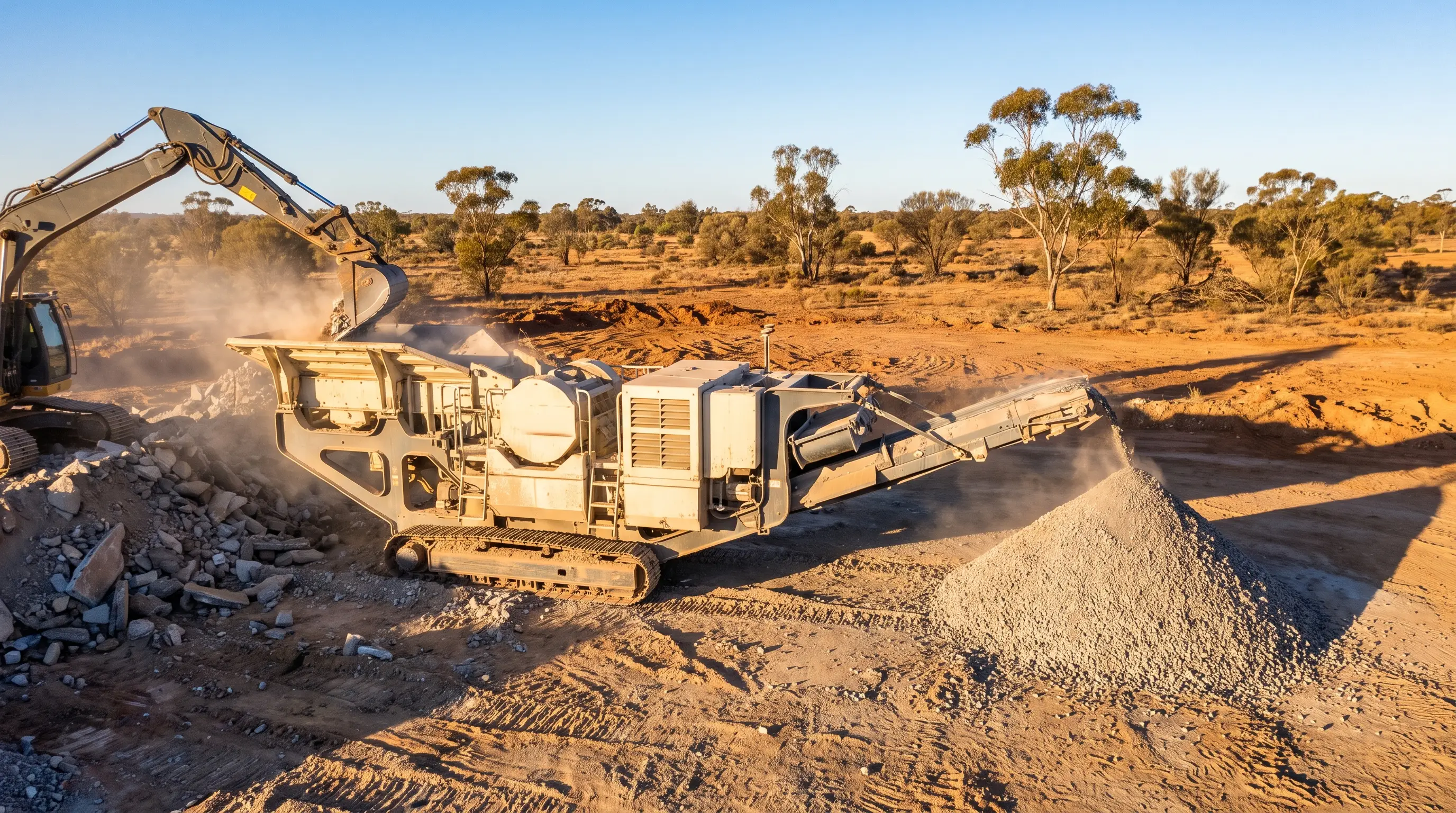
Most pricing guides for concrete crushers quote US dollars and assume the buyer is an American contractor. Type “what does a concrete crusher cost” and you get a list of US MSRP figures written for a crew in Ohio, not a civil contractor pricing a job in Brisbane or Perth. Turn those numbers into an Australian quote and they fall apart. Transport costs differ, tipping fees differ, and the machines you can actually get delivered locally are a shorter list than the US catalogues suggest. This guide runs the other way: real purchase benchmarks, real Australian hire rates, and a decision framework built on how many weeks a year you actually crush.
What a concrete crusher actually costs to buy
Almost every published list price for this equipment is a US figure, which makes it a weak guide to what you will actually pay here. What those lists do give you is the shape of the market. A mini jaw crusher sits well under A$100,000. A compact tracked jaw runs into the low-to-mid hundreds of thousands. A fully specced compact impactor, the kind carrying an on-board screen and return conveyor, can push past A$1 million by the time it is landed and commissioned.
The bands are wide on purpose. Where a particular machine falls inside one depends on the options list, the warranty, the exchange rate on the day, and what it costs to get the thing to your yard. None of that is covered by a US list price: sea freight, customs duty, GST, Australian compliance work and commissioning all sit on top, and the exchange rate moves between the day you are quoted and the day the machine arrives. For a number you can actually build a budget on, you need a quote written in Australian dollars by someone who imports the machine. jawscrushers.com.au is Australia’s leading dealer for Rubble Master, Komplet, EzyStak and Cayvol, supplying mobile crushers, screeners, shredders and material handling equipment for sale and hire Australia-wide, so the number you get there is a real Australian landed figure, not a US catalogue guess.
Why the cheapest machine is rarely the cheapest
Mini, compact, and full-size crushers are not the same machine at three price points. A compact crusher has more production capacity than a mini crusher, takes a bigger feed, and is best fed by a 14–17-ton excavator, which is why it costs more. Impact crushers cost more than jaw crushers because they have more moving parts. In exchange, an impactor produces a finished aggregate product with fines for compaction, while a jaw produces a 3-6 inch non-compactable material suited to backfill or further processing.
The on-board screen and return conveyor on a compact impactor is the other cost driver. It enables closed-loop production of spec material, and without it you cannot produce a homogenous product like a ¾-inch base in a single pass without rehandling. Buy the cheaper jaw and then need screened spec base, and you are paying for a second machine or a screen anyway.
What Australian contractors actually pay to hire
Dry hire rates in Australia are priced by machine class. A single toggle jaw in the 50–100 tph band runs $900–$1,100 per day, and a tracked jaw in the 150–300 tph band runs $1,400–$1,650 per day. Weekly rental for a compact machine is $2,500–$3,500, while monthly rental for a larger crusher often hits $8,000–$12,000.
The day rate is never the whole cost. Transport runs $1,000–$3,000 each way depending on float distance, fuel burns $30–$50 per hour while the machine runs, and wear parts on jaws, liners and belts cost $500–$1,000 per week. This is why crusher hire in Australia is quoted per job, not per day: the number on your quote depends on half a dozen variables a flat day rate cannot capture.
On-site crushing versus hauling it away
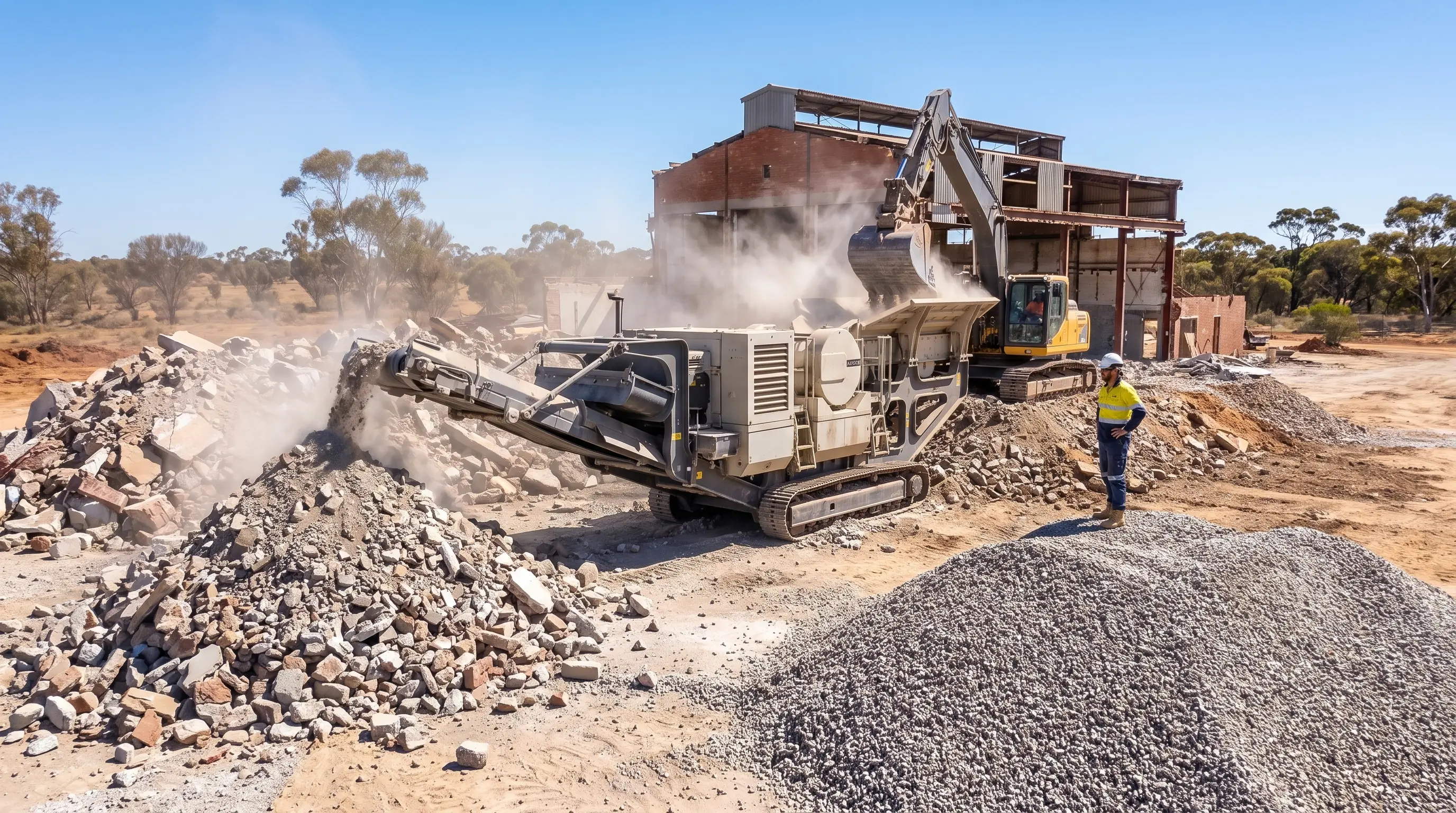
The comparison that actually matters is two-sided. Every load of demolition debris you send to a landfill costs you twice: once in trucking and tipping fees to get rid of it, and again when you buy and haul in fresh base, fill or road stone to replace it. Crushing on site removes both legs of that trip, and the economics are real: on-site crushing has an average return on investment period of less than five months at minimal volumes. US operators running it as a service report five-figure daily revenue, though Australian tipping fees and haul distances will move that in either direction.
Three usage bands that settle hire versus buy
Annual usage is the cleanest way to cut the decision. Light use, fewer than four weeks a year, costs around $8,000 in hire once you add delivery and pickup, and hire is the obvious choice. Medium use of five to twelve weeks lands near $28,000 a year, at which point you should at least run the numbers on a used machine or a lease, because the hire bill is approaching a down payment. Heavy use beyond three months reaches about $56,000 a year, close to the yearly cost of owning a crusher.
Budgeting the purchase and matching the machine
An entry-level crusher that does real work, not a toy, starts in the low hundreds of thousands. Large units start higher again and climb fast from there once you add options and a warranty package.
On the tax side, ignore the US Section 179 rule that American buying guides lead with. There is no Australian equivalent at this price point. The instant asset write-off here is capped at A$20,000 per asset for businesses turning over under A$10 million, so no crusher comes close to qualifying. A machine at this price goes into the small business general pool instead, deducted at 15% of its cost in the income year it is installed ready for use and 30% of the pool’s opening balance each year after that. Businesses above the turnover threshold depreciate over the asset’s effective life under the general rules. Either way the deduction is spread across years rather than banked in one, so run the numbers past your accountant before they shape your purchase timing.
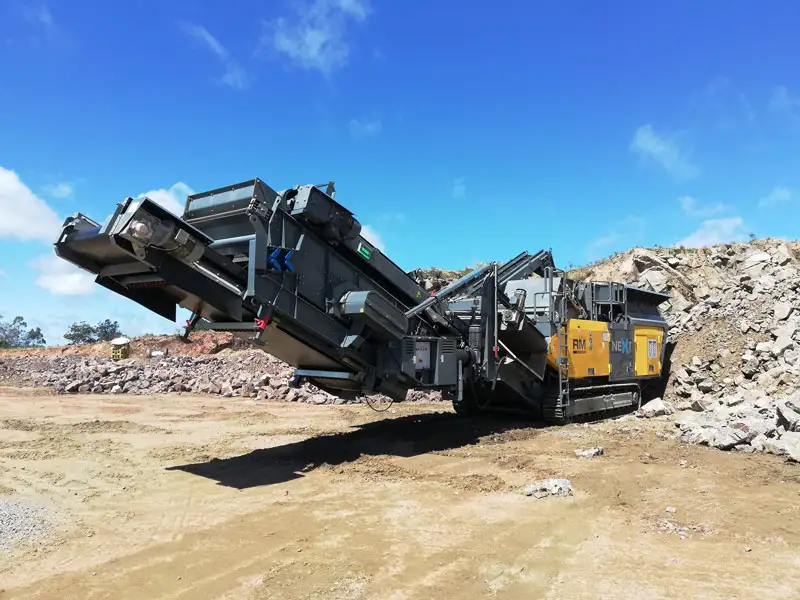
Then match the machine to the material. Jaw crushers suit hard, abrasive rock and primary reduction where you want a controlled top size; impact crushers shine on concrete, asphalt and construction waste, producing a cubical product and liberating rebar cleanly. In the compact range, the Komplet K-JC 704 is a tracked jaw rated to 80 tph through a 680 × 400 mm jaw at 12,000 kg, producing a 20–80 mm product from reinforced concrete, brick and rock. The RM 70GO! 2.0 impactor pushes up to 150 tph through a 755 × 600 mm inlet with an on-board screen and return conveyor for closed-loop production. For bigger jobs, Rubble Master impactors span 150–350 tph and the RM J110X jaw runs to 450 tph for hard rock, while the Komplet compact jaws reach 140 tph on the K-JC 805 where access is tight.