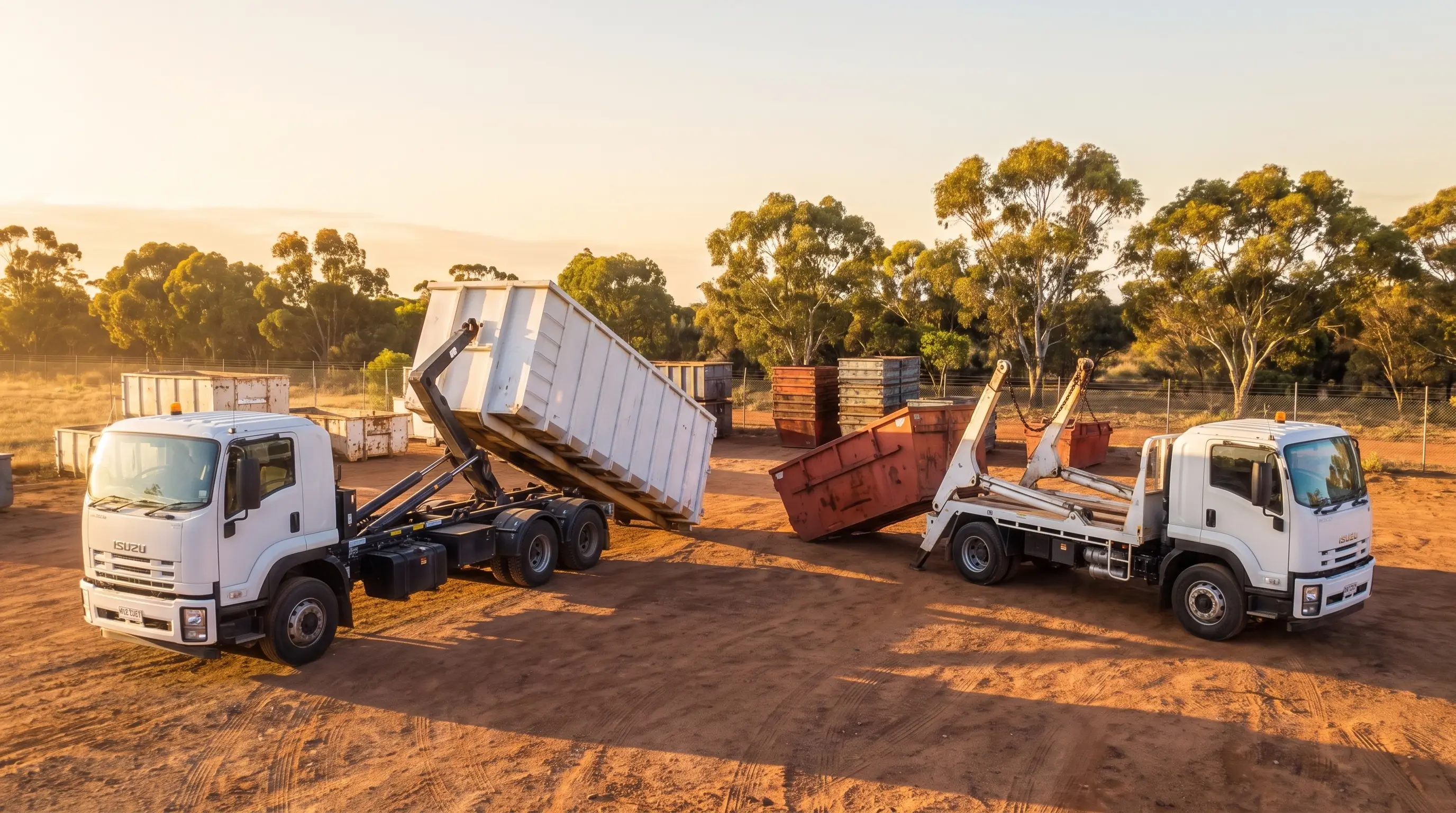
Ask most Australian operators what the truck that picks up their bins is called and you will hear one answer: “skip loader.” The term has become a catch-all, a shorthand that lumps two mechanically different systems under one name. That works fine in conversation. It gets expensive when you are speccing a body, because a hooklift and a skip loader attach to completely different containers. Buy the wrong one and you own a truck that cannot pick up the bins you already run.
A hooklift uses a hook arm to load, carry and swap roll-on/roll-off containers. A skip loader uses lifting arms to pick up, cart and tip open skip bins. Start with the containers you run, then match the body. For a side-by-side on the two, see our skip loader or hooklift breakdown.
Three systems share one name
The broader market recognises three types of skip loader: roll-on/roll-off, cable lift and hook lift. Only two of them are common on Australian roads today. The cable lift uses a winch to pull the bin up and over the side of the truck, a design that has largely given way to the hydraulic systems that now dominate Australian fleets.
A hooklift mounts a hydraulic hook arm to a truck chassis. The arm extends rearward, grabs the bail bar of a roll-on/roll-off container, and pulls it up onto the truck bed. The same arm slides the container back off at the other end, so one truck and one operator can load, cart and swap containers without a crane or a second machine on site.
A skip loader uses lifting arms rather than a hook. The arms reach back, grab an open skip bin by its lifting points, and haul it onto the chassis. The same arms tip the bin to empty it.
Containers decide the system
The decision starts with what you already move. If you run roll-on/roll-off enclosed containers, you need a hooklift. If you run open skip bins, the kind you see on construction sites and driveways, you need a skip loader. The body must match the containers, not the other way around.
The Cayvol Multivol is the hooklift in the Jaws Crushers range, rated from 18 to 30 tonnes across three configurations. The range spans a telescopic version (MV-22/65), an articulated version (MV-15/50CA) and a semi-trailer version (SRMV-30/70). The Multicontainer is the skip loader. It comes in two versions: the MCSB-14 with fixed arms for straightforward lifting, and the MCBT-14L with telescopic arms for extra reach when loading from awkward positions or handling a wider range of bin sizes.
| Hooklift | Skip loader | |
|---|---|---|
| Mechanism | Hydraulic hook arm grabs the bail bar | Lifting arms grab the side points |
| Container | Roll-on/roll-off enclosed | Open skip bins |
| Empties by | Sliding the container off | Tipping the bin |
| Cayvol body | Multivol, 18 to 30 t | Multicontainer (MCSB-14, MCBT-14L) |
Match the system to the work
Hooklifts and skip loaders suit different duty cycles. The Multivol covers waste and recycling collection, construction and demolition container handling, roll-on/roll-off transport, and landfill and wastewater duty cycles. An HD range stands up to the relentless lift cycles of landfill and wastewater operations.
The Multicontainer covers skip-bin collection and delivery, waste and recycling, and construction and demolition bin handling.
Across the industry, hook lift trucks run a hydraulic or electrical hoist and serve forestry, construction, demolition, scrap, waste and recycling. They load and unload at ground level. A hooklift can engage a container up to 30 degrees off-center, which helps in tight spaces. Bodies switch out in about 2 minutes. The operator stays in the cab during loading and unloading instead of standing near moving equipment.
Cayvol versus MULTILIFT
MULTILIFT is a brand, not a category. It is one of the major hooklift and skiploader manufacturers under Hiab, with origins going back to 1949 when the Terho brothers patented the world’s first demountable cargo system. The flagship Futura skip loader carries EvoLight construction, SwanNeck reach geometry, FlexControl, SkipTop 2.0 and SafetyPlus features.
If someone pitches you a Cayvol, you are looking at a product backed by Jaws Crushers in Australia. jawscrushers.com.au supplies both Multivol hooklifts and Multicontainer skip loaders through Cayvol. Both brands make hooklifts and skip loaders; the difference comes down to local support, parts availability and how the body is built.
Cayvol builds the Multivol from bolted modules rather than structural welds, so sections can be replaced and the unit rebuilt rather than scrapped. Nylon column guides and combined hydraulic and pneumatic control keep the electronics and failure points to a minimum. A radio remote and an integrated weighing cell are available to speed handling and capture load weights.
New, used, or rent
A new Cayvol Multivol or Multicontainer comes with modular construction, minimal electronics and the benefit of being specced to your exact chassis and container fleet. Used equipment costs less upfront, but the trade-off is unknown maintenance history and a body that was specced for someone else’s containers. Renting a hooklift or skip loader for a few months gives you real-world cycle data before you commit to a purchase. If you are budgeting, what a hooklift truck costs to buy, fit out and run breaks down the numbers.
When you spec, three in-cab control systems are on the table: hydraulic, pneumatic and electrical. Choose lifting capacity based on the weight you haul, and leave room to grow rather than buying to today’s limit.