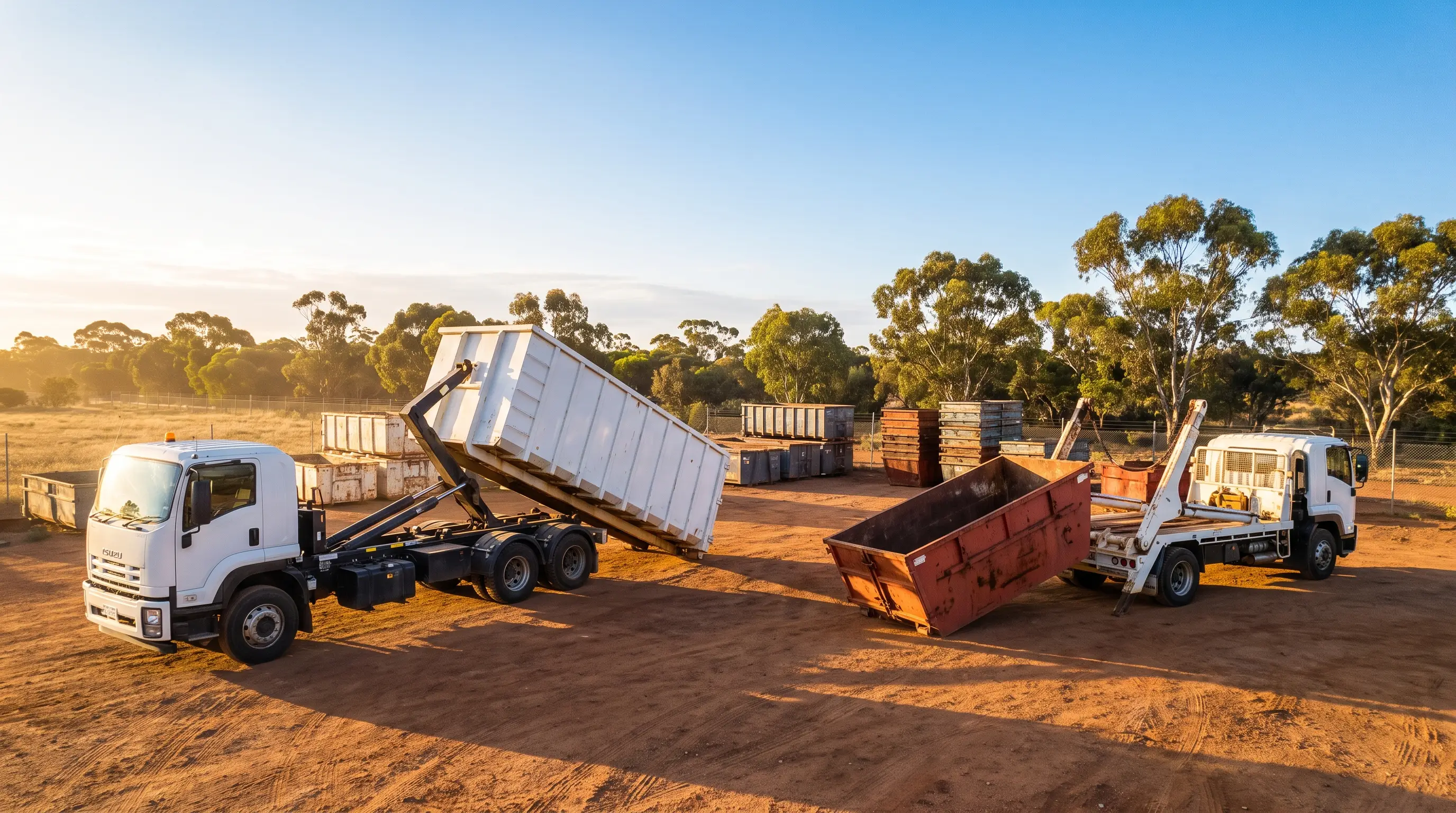
Quick answer: A hooklift uses a hook arm to load, carry and swap roll-on/roll-off containers. A skip loader uses lifting arms to pick up, cart and tip open skip bins. The right choice starts with the containers you already run.
Walk into any skip bin yard in Australia and ask what the truck is called. Nine times out of ten you will hear “skip loader.” The term has become a catch-all, a shorthand that lumps two mechanically different systems under one name. That works fine in conversation. It causes expensive mistakes when you are speccing a body.
A hooklift is not a skip loader. A hooklift uses a hook arm to grab, pull and carry roll-on/roll-off enclosed containers. A skip loader uses lifting arms to pick up, carry and tip open skip bins. Same truck, same operator, completely different attachment points and container types. Get the distinction right and you buy a body that fits the fleet you already have. Get it wrong and you own a perfectly good truck that cannot pick up your bins.
Jaws Crushers sells both systems through Cayvol, so they are not in the business of pushing one over the other. The question is which one matches your containers.
What a hooklift does
A hooklift mounts a hydraulic hook arm to a truck chassis. The arm extends rearward, grabs the bail bar of a roll-on/roll-off container, and pulls it up onto the truck bed. The same arm slides the container off at the other end. One truck loads, carries and swaps containers without a crane or a second machine on site.
The Cayvol Multivol is the hooklift in the Jaws Crushers range, rated from 18 to 30 tonnes across its versions. That spread covers everything from light collection runs through to heavy roll-on/roll-off transport.
The Multivol frame is bolted together, not welded. Sections can be replaced and the unit rebuilt rather than scrapped when something wears. Nylon column guides and combined hydraulic and pneumatic control keep the electronics and failure points to a minimum, which matters on hard waste and recycling duty cycles. A radio remote and an integrated weighing cell are available to speed handling and capture load weights.
For the hardest duty cycles there is an HD range built for the relentless lift cycles of landfill and wastewater operations.
What a skip loader does
A skip loader uses lifting arms rather than a hook. The arms reach back, grab an open skip bin by its lifting points, and haul it onto the chassis. The same arms tip the bin to empty it. The system is built for open skips, the kind you see on construction sites and residential driveways.
The Cayvol Multicontainer is the skip loader in the range, a skip-bin body that loads, carries and tips open skips from a single truck. It comes in two versions: the MCSB-14 with fixed arms for straightforward, robust lifting, and the MCBT-14L with telescopic arms for extra reach when loading from awkward positions or handling a wider range of bin sizes.
Like the Multivol, the Multicontainer is built on Cayvol’s modular construction. The body is serviceable and components can be replaced rather than scrapped. That shared design philosophy means both systems follow the same maintenance logic: hydraulic and pneumatic systems, bolted assemblies, minimal electronics.
Which one fits your fleet?
The decision is simpler than most spec sheets make it look.
If you run roll-on/roll-off enclosed containers, you need a hooklift. The hook arm grabs the bail bar and the container rides onto the chassis. That is the Cayvol Multivol.
If you run open skip bins, you need a skip loader. The lifting arms pick up the bin by its side points and tip it. That is the Cayvol Multicontainer.
Either way you get one truck and one operator. The truck swaps containers on its own. The difference is the container type your business already runs. Do not let a sales rep talk you into converting your container fleet to match a body. The body should match the containers.
The broader market recognises three types of skip loader: roll-on/roll-off, cable lift and hook lift. The cable lift uses a winch to pull the bin up and over the side of the truck, a design that has largely given way to the hydraulic systems that now dominate Australian fleets. The roll-on/roll-off and hook lift systems are the two you will actually see on the road.
How MULTILIFT fits in
MULTILIFT is a brand, not a category. It is one of the major hooklift and skiploader manufacturers under Hiab, with origins going back to 1949 when the Terho brothers patented the world’s first demountable cargo system. The brand covers both hooklifts and skiploaders, so you will hear the name in the same conversations as Cayvol, Palfinger and Hyva.
MULTILIFT hooklifts cover a range of capacities and product lines. The Futura is the flagship skip loader, with EvoLight construction to save weight and increase payload, SwanNeck reach geometry, FlexControl for operator freedom, SkipTop 2.0 automatic cover system, and SafetyPlus features.
Knowing the brand landscape matters when you are comparing quotes. If someone pitches you a MULTILIFT, you are looking at a Hiab product. If someone pitches you a Cayvol, you are looking at a product backed by Jaws Crushers in Australia. Both make hooklifts and skip loaders. The difference is local support, parts availability and how the body is built.
Rental and parts considerations
Hooklifts and skip loaders share the same maintenance DNA. Both run on hydraulic and pneumatic systems with bolted modular construction. The service schedule looks similar regardless of which system you run.
For MULTILIFT equipment, original spare parts are available through the Hiab webshop, including proximity sensors, slide pads, controllers and electric cables. Third-party dealers also stock replacement parts for MULTILIFT hooklifts alongside parts for Galfab, Palfinger, American Roll-Off and Stellar.
For Cayvol equipment, the modular construction means most wear components are replaceable without scrapping the unit. That changes the maths on whole-of-life cost. A bolted body that can be rebuilt section by section has a different depreciation curve than a welded body that needs to be replaced as a unit.
Rental is an option worth considering when you are testing a new container type or entering a new market. Renting a hooklift or skip loader for a few months gives you real-world cycle data before you commit to a purchase. It also lets you confirm which container type your customers actually want before you invest in a body and a matching bin fleet.
Buying new vs used
New equipment carries a factory warranty and the latest design revisions. A new Cayvol Multivol or Multicontainer comes with modular construction, minimal electronics and the benefit of being specced to your exact chassis and container fleet.
Used equipment costs less upfront. The trade-off is unknown maintenance history and a body that was specced for someone else’s containers. A used hooklift that spent its life in landfill duty cycles will have different wear patterns than one that ran light collection work. If you go used, check the hydraulic system thoroughly, inspect the lift arms or hook for wear, and confirm the body is compatible with the containers you already run.
A new unit from Jaws Crushers is specced to your truck and your bins. That match is worth more than the difference in price on a used unit that was built for a different fleet. Talk to Craig about fitting a Multivol or Multicontainer to your truck.