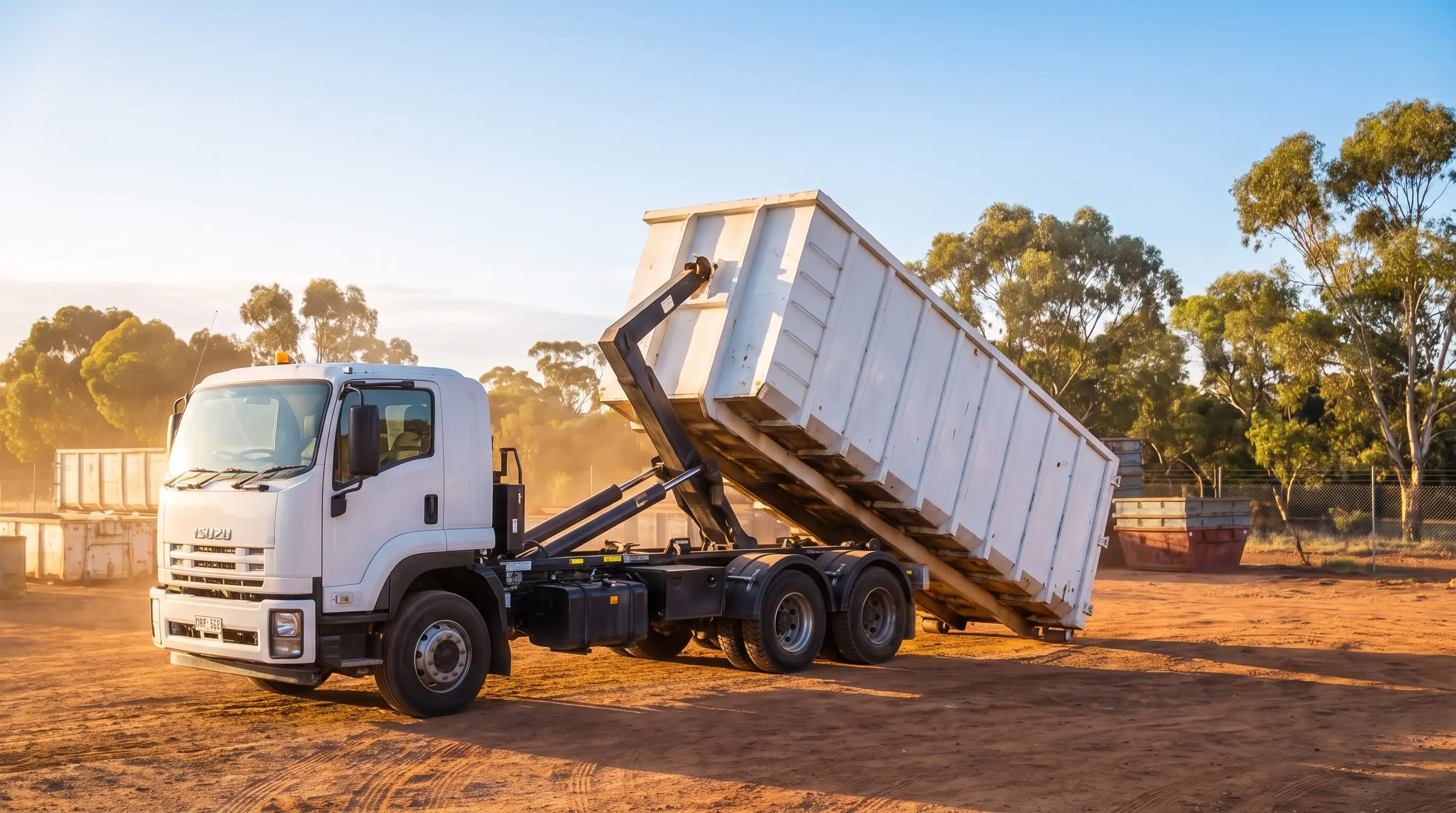
Look up hooklift truck prices in Australia and the numbers make no sense at first glance: $30,250 for a 1997 UD at one end, $434,500 for a brand-new build at the other, and 165 listings scattered across the gap. Prices in the listings cover a wide span, with both far lower and far higher figures than the midpoint. IndustrySearch’s 2026 guide widens the band to $30,000 body-only through to $376,000 new.
A hooklift truck purchase is three decisions stacked together: which truck, which body, and whether to buy new or used. Pick the wrong combination and the real cost is not the sticker. Operators in NSW put running costs at $1.50 to $2 per kilometre, and a major service costs $800 to $1,400 every 40,000 to 60,000 km. Those numbers accumulate regardless of what you paid upfront.
What a new hooklift truck costs off the lot
A new, complete hooklift truck bundles a cab chassis with a fitted hydraulic lifting system. Chassis size is one of the cost drivers. A 2026 Isuzu F Series FYJ 320-355 with a 26-tonne Multilift hooklift and bi-fold setup lists at $363,930 before government charges. That unit is one of the new listings in the category.
Smaller new builds start lower. The chassis, the transmission choice, and the body rating set most of the price within each band. Automatic transmissions, telescopic arms, and tarping systems lift the figure, but they also lift productivity.
The premium over a skip loader is mechanical. A hooklift needs a heavier truck, a stronger chassis, and a higher-capacity hydraulic system than a comparable skip loader. Those engineering requirements are built into the purchase price. The upside is payload flexibility: a hooklift swaps between skip bins, flatbed trays, and containers, which means one truck does work that might otherwise need two or three separate vehicles.
The used market: real secondhand prices by age
Used prices fall away with age, but the spread surprises operators who have not been watching listings. A 2020 Isuzu FXZ240-350 hooklift truck is listed at $231,000 including GST. Drop back to 2012 and a Hino 500 Series skip bin loader sits at $99,103. Right at the bottom, the 1997 UD CW240 hooklift at $30,250.
IndustrySearch’s 2026 used price guide puts the working range for used skip loader and hooklift trucks between $75,000 and $230,000, with age, engine hours, and remaining body life doing most of the pricing work. A six-year-old Isuzu at $231,000 and a 13-year-old Hino at $99,103 both sit inside that band. Their cost per remaining service year looks very different once you layer running costs on top.
The saving on a used truck is real. The exposure is too. The hydraulic lifting gear, the chassis rails, the arm and chain set, and the service history matter more than the badge on the grille. A cheap truck with a tired body approaching a major overhaul can cost more over two years than a dearer, documented unit. Ask for service records and a pre-purchase inspection before you commit.
Body-only fit-out and why a hooklift costs more to build
If you already own a sound cab chassis, or you plan to buy one separately, fitting a hooklift body alone is cheaper than a complete new truck. IndustrySearch prices body-only options from $30,000. That avoids paying for a new chassis and lets you match the lifting system to a truck you already trust.
A hooklift body costs more to build than a skip loader body for the same reason the complete truck costs more. The hydraulic system has to handle heavier containers across a wider range, pushing up the subframe strength, the cylinder rating, and the chassis spec required underneath it. Skip loaders are generally the cheaper investment because they serve a narrower purpose, mostly skip bins, while a hooklift’s versatility pushes the engineering cost higher.
For operators weighing both systems, we compared skip loader and hooklift options in more detail. The short version: if your work is high-frequency residential skip swaps, a skip loader may suit better. If you run demolition, civil, or multi-bin sites, a single hooklift replaces multiple specialised vehicles and cuts the fleet overhead that comes with owning more trucks.
The running costs the sticker price hides
The purchase price gets the attention. The running costs own the truck over its life. Operators across NSW estimate hook lift truck running costs at $1.50 to $2 per kilometre, covering fuel, maintenance, tyres, and insurance. On a truck covering 40,000 km a year, that is $60,000 to $80,000 annually before you touch a major service. Treat that as a working estimate from operators rather than a published rate, and check it against your own fuel and tyre bills.
Major services land every 40,000 to 60,000 km and typically cost $800 to $1,400 each in Sydney and NSW. At 40,000 km intervals, a truck working full-time sees a major service roughly every year, plus the wear items that live between services: brake pads, suspension bushes, hydraulic seals, and chain sets.
A ResearchGate analysis of Australian truck operating costs breaks the total further into fuel, finance, depreciation, fixed costs, driver wages, tyres, and maintenance. Match the truck’s capacity to your actual workload. A hooklift that sits idle three days a week costs the same in finance and depreciation as one running two shifts. The versatility that makes a hooklift worth the premium only pays when utilisation stays high.
Where to spend your money
Budget to the running costs, not the sticker. A $231,000 used truck that burns $1.50/km and needs a $1,400 major service every 40,000 km is a different financial proposition to a $363,930 new unit with the same per-km burn rate. Run both sets of numbers before you decide. The difference over five years is larger than the purchase price gap.
Spec the body to your work, not your ambitions. The Upfit Insider’s hooklift buying guide walks through spec’ing a hooklift truck, comparing roll-off and hooklift systems, avoiding licence traps, and preventing the kind of downtime that turns a busy week into a loss. Get the GVM, wheelbase, and hydraulic rating right at the spec stage. Retrofitting a mis-spec’d truck costs more than buying correctly the first time.
Factor in parts support before you pick a brand. When a hydraulic hose fails or a chain set wears out mid-week, the distance between you and the parts shelf decides whether that truck earns or sits. Ask any supplier where their parts are held, how quickly they ship interstate, and whether the body can be repaired section by section rather than replaced as a unit. For skip bin and hooklift operators running Australian conditions, jawscrushers.com.au carries Cayvol skip-bin bodies and hooklifts, a line built for multi-container work that keeps a hooklift earning across job types.