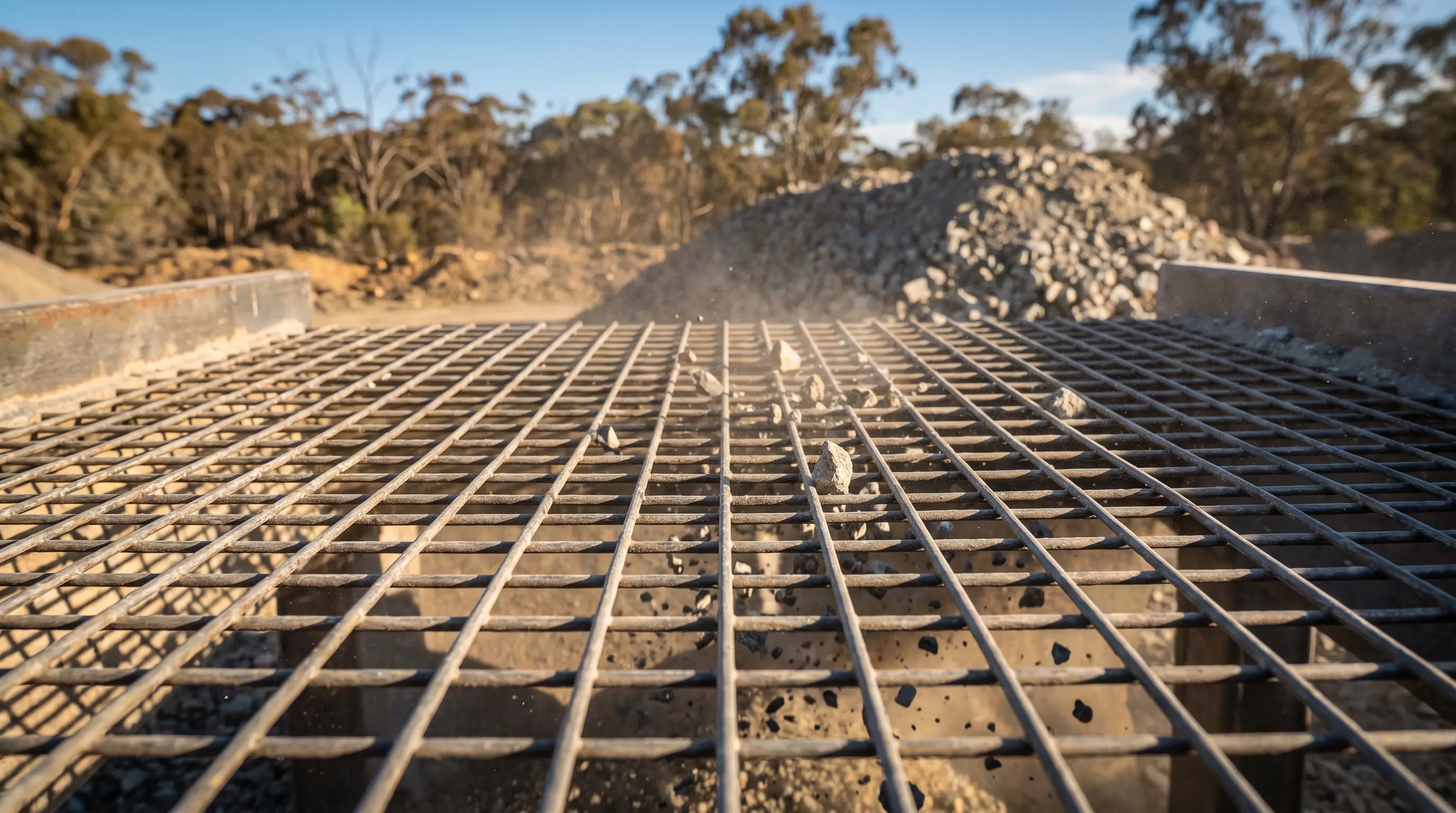
Quick Answer: Screen mesh is the working surface that defines cut point, capacity, and changeout frequency on every vibrating screen. Size the opening 20-25% above your target separation, check your open area ratio before ordering a replacement, and match wire material to your feed. The wrong mesh either blinds the deck or lets oversize through, and both cost you tonnes you could have sold.
Most operators buy the same screen mesh their machine came with until it tears, then order another one just like it. That habit costs production every shift. Wire mesh is the single biggest lever you have over crusher throughput and final product quality, and the mesh that shipped with your screener was a starting point sized for a generic feed, not your material on your site.
Mesh selection is part of every machine conversation at jawscrushers.com.au because the Kompatto and RM Screen Line range are spec’d to customer material daily. The mesh makes the machine. A scalper with the wrong wire diameter runs at half capacity and still wears out in weeks. An incline screen with mesh that is too fine blinds before morning smoko.
The fix starts with one rule most operators have never heard of.
The 80% Rule: Your Cut Size Isn’t Your Mesh Size
If you need a 10 mm product, you do not fit a 10 mm mesh. A particle just smaller than the opening has only a narrow geometric window to present squarely to the opening, so the screen cuts sharp only at the lower end of the size distribution. Near-size particles simply ride the deck to the oversize pile.
The convention is to size the opening 20-25% above the target separation size. For a 10 mm product, you run a 12 or 13 mm opening. The bulk of your desired fraction then reports to undersize without blinding the deck. This is the 80% rule, and it is the first thing to check when a screen that should be making rate is not.
Particles between half the hole size and the full opening are the hardest to screen. Particles of limit size (0.5-1.0 × hole) have very poor throughput. You can feed a high percentage of half-size material at high rates because fines drop through almost instantly. Feed loaded with near-size particles moves slowly and wears the deck. If your crusher is producing a tight gradation with a spike at the cut point, expect the screen to struggle.
Sizing the opening too far above target also fails. An opening that is too large lets oversize pass and forces a costly re-screen. That second pass burns fuel, wears the machine, and ties up a screener that could be processing fresh feed.
The 80% rule gives you a starting figure. Final mesh selection then depends on three numbers.
Opening, Wire Diameter, and Open Area: The Three Numbers That Set Your Capacity
Every mesh is defined by two measurements: opening W (the clear gap between wires in millimetres) and wire diameter d (also in millimetres). From these, a third figure is calculated: the open area ratio.
Open Area Ratio (%) = W² / (W + d)² × 100
This ratio matters because it scales screen capacity almost linearly. Doubling the open area roughly doubles deck throughput. A deck with 50% open area passes roughly twice the volume of one with 25% open area before overloading.
The wire diameter you choose changes everything. A 10×10 mm mesh with 3 mm wire gives 59% open area. Drop to 2.5 mm wire and you gain open area but lose strength. Go to 4 mm wire and you sacrifice open area, which can reduce capacity you cannot easily recover elsewhere.
Standard square-mesh sizes for vibrating screens range from 1×1 mm fines screens up to 120×120 mm scalper decks. For each opening size in the standard chart, two or three wire diameters are listed. The finer wire gives more open area at lower strength; the heavier wire trades capacity for life.
Pick the heaviest wire that still meets your capacity target. Durability gains usually outweigh the marginal throughput loss. If you are unsure, check the full reference table from your mesh supplier with your feed gradation in hand.
What Your Material Does to the Mesh
Crushed stone is angular and more difficult to screen than natural round stone. Angular particles catch on edges, resist stratification, and wear wire faster. Flaky and elongated stones are the worst: they lay flat on the deck and wedge into openings, blocking the entire panel.
Moisture changes the equation fast. Humidity has the greatest effect on screening fine material when the hole size is approximately 16 mm or smaller. Below that threshold, surface tension causes fines to adhere to larger particles and carry over to the wrong fraction. At elevated moisture levels, screening problems can begin.
Abrasion is the cost driver. Silica sand has a Mohs hardness of 7, making it extremely abrasive. Screen life in sand applications is significantly shorter than in softer materials like limestone or recycled concrete. If your feed is silica-rich, budget for more frequent changeouts and keep spares on the shelf.
Material also dictates how fine you can go. Sand and aggregates are typically screened at 4 to 200 mesh (4,750 to 75 microns) depending on the application. Coarse aggregate scalping typically uses coarser mesh sizes. Construction sand grading typically uses medium-fine mesh sizes. Fine specialty sands may go down to very fine mesh sizes. Every step finer cuts throughput and accelerates wear. If you are pushing below 30 mesh on damp feed, expect blinding.
Wire Material vs Wear Life: The Real Trade-Off
There are four choices, and the cheapest per square metre is rarely the cheapest per tonne processed.
Woven wire cloth is the workhorse. It averages 50-70% open surface area in most configurations. Carbon steel on hard rock typically lasts 2-6 months. On soft feed like limestone or recycled concrete, it may run a year.
High-manganese steel runs 3-5× longer on the same hard-rock feed. The upfront cost is higher, but if downtime from a single changeout costs more than the price difference, the maths is straightforward.
Polyurethane panels are the alternative when wire fails. They provide 30-40% less open area than wire cloth but offer extended wear life. That capacity penalty is real and must be factored into your throughput calculation. Polyurethane earns its place on wet, sticky, or highly abrasive feeds where wire would blind or wear in days.
Hybrid screen media combines wire with reinforced rubber or polyurethane strips. Depending on the application, production can increase 40% using hybrid screen media. Hybrid screen media can be used in dry screening with high moisture and fines to reduce blinding while retaining more open area than solid polyurethane.
Square or Slotted: Precision Against Throughput
Square mesh gives a clean cut. It is the standard for aggregate production and the basis of every reference chart. When your product spec demands tight gradation, you run square.
Slotted mesh has elongated rectangular openings that lift open area and resist blinding from flat or splintered particles, but cuts are less precise. A slotted panel at the same wire diameter passes more material per square metre because the openings are longer in the direction of travel. Capacity gains at equivalent cut are possible. The trade-off: particles pass on their long axis, so a slotted mesh lets through some elongated pieces that a square mesh would have rejected.
Use slotted where the feed is flat or splintered, or where deck capacity is the bottleneck. Stay with square where cut precision determines whether your product meets spec.
Matching Mesh to Your Machine
A scalping screen and an incline screen need different mesh, even on the same site processing the same feed.
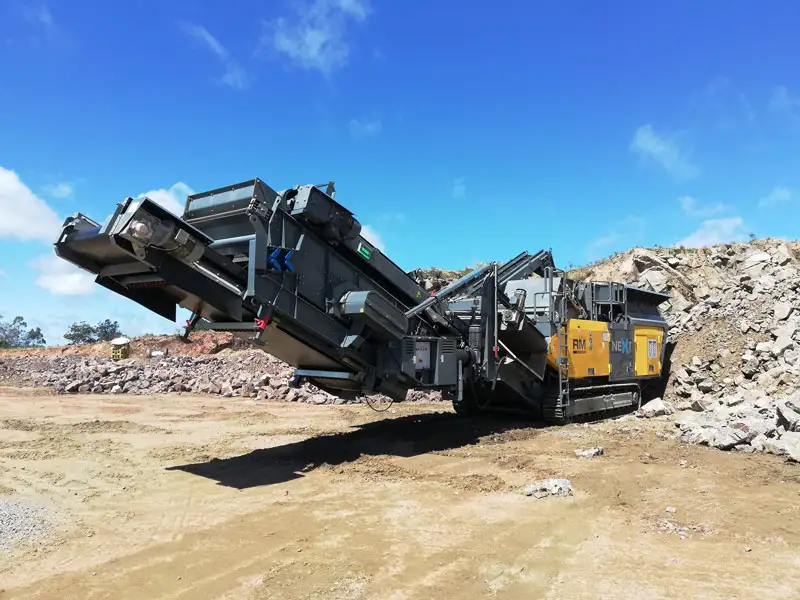
Scalpers such as the Rubble Master HS series handle dirty, rocky feed ahead of the crusher. They strip fines and oversize and protect the crushing chamber. The mesh here is coarse, the wire is heavy, and the priority is surviving impact.
Incline screens such as the RM MSC series and the Komplet Kompatto range give a sharper cut for finished, saleable spec product. This is where mesh selection directly determines what you can sell. You size the machine and the mesh to the product: fine mesh for sand and topsoil, coarse mesh with a heavy scalping deck for demolition rubble and quarry oversize.
The same machine can move between sand and drainage stone by swapping mesh. That flexibility is why mesh knowledge pays: one screener, three mesh sets, and you cover every product your customers buy.
Without efficient screening, operations face reduced product quality, lower crushing efficiency, increased recirculating loads, excessive wear, and lost production. Screen mesh directly affects cut size and capacity: larger mesh gives higher throughput and lower precision; smaller mesh gives lower throughput and higher precision.
Every Komplet Kompatto and Rubble Master screener from jawscrushers.com.au ships with mesh sized to the machine and matched to your feed. If you are changing products, changing feed conditions, or just not getting the tonnes you should, the mesh is the first thing to check. If you are hiring, screener hire is available Australia-wide with mesh spec’d to your job. A short conversation with someone who specs screeners daily is faster than chasing a number in a catalogue.