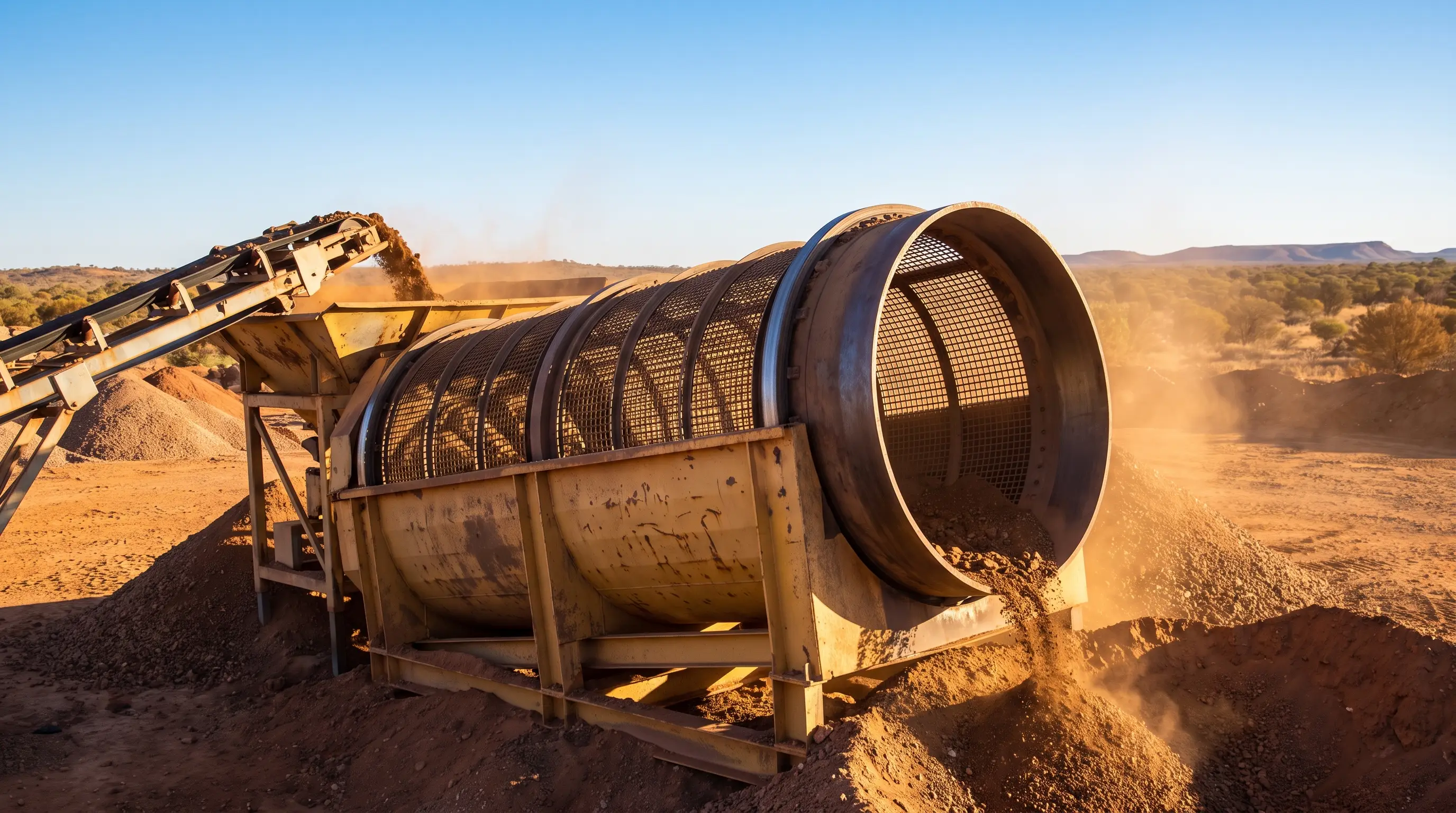
If you are an Australian contractor staring at a stockpile that has gone sticky after three days of rain, the screening question stops being theoretical. That vibrating screen you planned to use will blind in under an hour. A trommel screen would keep running and keep producing. The trick is knowing when to reach for one.
What a Trommel Screen Is
A trommel screen is a rotating cylindrical mesh drum that sorts materials by size. Material enters at the feed end, the drum rotates, and particles smaller than the perforations fall through while larger pieces travel the length of the drum and discharge at the far end. The name comes from the German word for drum, and the machine has earned its place on sites where flat decks fail.
Two things set a trommel apart from other screening equipment. It relies on rotation and gravity, not oscillation, to move and separate material. And it breaks down clumps as it screens. That second point matters more than most operators realise. A vibrating screen separates; a trommel separates and conditions.
How a Rotating Drum Separates Material
The process is mechanical and direct. As the drum spins, lift bars turn material over allowing smaller particles to fall through perforations while larger pieces continue along the length of the drum and exit at the end. Every undersized particle gets multiple chances to find a hole. The tumbling motion presents material to the mesh again and again.
Four variables determine how fast and how clean the separation runs. Drum rotation speed, typically 10 to 25 RPM. Drum incline angle, usually 3 to 7 degrees. Drum length and mesh size round out the set. Speed controls how aggressively the material tumbles. Incline controls how fast it moves through the drum. Length and mesh size together determine how many chances a particle gets to drop through before it discharges.
Movement down the drum happens through either a pitched variable angle on the drum itself or a scrolled lift bar inside it. The choice is not arbitrary. It leads straight to the two drum designs that dominate the market.
Two Drum Designs, Two Kinds of Material
The drum inside a trommel screen comes in two configurations, and picking the wrong one for your feed turns a productive day into a slow fight.
Lift bar drums pitch the drum at an angle and use internal bars that lift and drop material as it spins. This lift-and-break action enhances separation by physically breaking apart clumps. They are built for organics: compost, mulch, topsoil. The effective screening area on a lift bar drum runs from roughly the 10 o’clock to 4 o’clock position on a clock face, giving more usable screen surface than the alternative.
Scroll drums, sometimes called rifled drums, use an internal corkscrew design to gently roll lighter materials like plastics, paper or shredded waste through the drum. They trade screening aggression for gentleness, avoiding the tangling and binding that fibrous materials cause on a lift bar setup. These are common in European-style recycling operations.
If you are screening compost or topsoil, you want lift bars. If you are processing mixed recyclables or shredded waste, the scroll drum keeps things moving without wrapping. The drum design follows the material, not the other way around.
Trommel vs Vibrating Screen: Pick Wrong and You Fight It All Day
The fundamental difference is mechanical. A trommel screen rotates. A vibrating screen oscillates. Vibrating screens use oscillating screen boxes to stratify and separate material across one or more decks. Trommels rely on rotation and gravity, not oscillation. These are not two flavours of the same machine. They are two machines for two different material profiles.
Trommels are especially useful for sticky, moist or organic materials like compost, topsoil, mulch or clay-heavy aggregates. Their tumbling motion prevents blockages, reduces screen blinding and often improves final product quality by physically breaking down material during screening.
Three properties make trommels uniquely valuable. Gentle action: the slow tumbling motion separates clumps without crushing or pulverising the material, critical for compost and topsoil where preserving structure matters. Moisture tolerance: wet material that would plug a vibrating deck screen passes through a trommel because the constant tumbling action prevents buildup on the mesh. Organics handling: branches, roots, sticks and clumps tumble to the discharge end and exit as oversize without entangling moving parts the way they would on a vibrating screen.
On the other side, vibrating scalping screens deliver higher throughput per footprint on dry material and aggregates. Choose a vibrating screen for processing dry or crushed aggregates such as sand, gravel or stone, when precision sizing is required for multiple clean products, or when you need higher throughput capacity.
| Trommel Screen | Vibrating Screen | |
|---|---|---|
| Mechanism | Rotating drum with mesh walls | Oscillating flat or inclined decks |
| Best material | Wet, sticky, organic (compost, topsoil, clay) | Dry aggregate (sand, gravel, crushed stone) |
| Throughput per footprint | Lower | Higher |
| Screen blinding risk | Low (tumbling action self-cleans) | High on moist or sticky feed |
| Material conditioning | Breaks down clumps during screening | Stratifies but does not condition |
| Organics handling | Branches and roots pass through cleanly | Tangling and wrapping risk |
The decision tree is short. If your material is dry and hard, go vibrating. If it is wet, sticky, or full of organics, the trommel screen is the tool that keeps running.
Five Jobs Where a Trommel Earns Its Keep
Trommel screens are best suited for materials that are moist or sticky like clay and compost, irregular or fibrous like mulch and shredded waste, or difficult to process with traditional flat deck screens. Here are the jobs where they dominate.
Topsoil screening. Raw excavated dirt runs through the drum and comes out as clean, graded topsoil while rocks, roots and clods discharge as oversize.
Compost and mulch processing. The gentle action separates finished compost from oversize material that needs more time, without damaging the compost structure.
Landfill reclamation and C&D waste management. Mixed waste streams separate into size fractions for further sorting or reuse. Common applications include topsoil screening, compost and mulch processing, landfill reclamation, C&D waste management, recycling of plastics, paper and wood, and cleaning aggregate with high clay content.
Cleaning aggregate with high clay content. Clay-heavy feed blinds a vibrating deck in minutes. A trommel’s tumbling action keeps the mesh clear and the product moving.
Extending seasonal productivity. Trommels are especially helpful in allowing screening during wetter months for materials like dolomite or wet topsoil that would shut down a dry-screening operation. If your site turns to mud every winter, a trommel screen stretches your working season by weeks.
When a Trommel Is the Wrong Tool
For all their strengths, trommels are not universal screeners. There are jobs where reaching for one costs you money in lost tonnage.
Dry crushed aggregates. Sand, gravel, and crushed stone screen faster and cleaner on a vibrating incline screen. Choose a vibrating screen for processing dry or crushed aggregates when you need precision sizing for multiple clean products or higher throughput capacity.
High-throughput operations. Vibrating scalping screens deliver higher throughput per footprint than trommels.
C&D recycling and concrete crushing. Here a scalping screen like the Rubble Master HS series strips fines and oversize before the crusher to protect the chamber and improve throughput. After crushing, an incline screen grades the output into clean, sized products. This is the natural pair for crushing circuits, and it is where most Australian contractors and recyclers live.
The pattern is straightforward. If your material is dry, hard, and you need volume, a trommel screen leaves tonnage on the table.
What Jaws Crushers Supplies Instead
jawscrushers.com.au supplies Komplet Kompatto incline screeners and Rubble Master scalping and incline screens. These are vibrating machines, not trommels. That is a deliberate choice for the Australian market and the material most contractors handle: dry crushed aggregate, recycled concrete, and C&D waste.
An incline screen like the Komplet Kompatto range gives a sharper, more accurate cut for aggregate producers making a saleable spec product. If you are cleaning up feed, you scalp. If you are making finished, sized stockpiles to sell, you screen on an incline. A mobile screener separates crushed or raw material into clean, sized fractions, creating the graded stockpiles buyers actually pay for. Instead of an unsorted heap, you produce road base, drainage aggregate, sand or topsoil to spec on site.
Pair a screen with a crusher and you turn raw feed into finished product in one pass. A Kompatto or Rubble Master screen sits naturally behind any Komplet or Rubble Master crusher, and the team at jawscrushers.com.au sizes the pair to your material and your daily target.
The honest advice: if your material is wet, sticky, or organic (compost, clay-heavy topsoil, municipal waste) you probably need a trommel screen. jawscrushers.com.au does not sell one, and they will tell you that. For everything else (dry aggregate, crushed concrete, C&D recycling, quarry scalpings) the Kompatto and Rubble Master incline screeners deliver higher throughput and sharper cuts. If you are not sure which camp you fall in, a conversation with someone who knows crushers and screeners is faster than a brochure.