Every shift your loader shuttles between the crusher and the pile it just built, sitting idle half the time with the meter still running. You are burning diesel and paying an operator to hold a machine in place so crushed product can pile up where it needs to go. A tracked conveyor stockpiler removes both those costs from the circuit, and the numbers are specific enough to run a real payback check on.
The Payback Math: 2.5 Years to Break Even
Operators who make the switch report the machine paying for itself in about 2.5 years on fuel and labour alone. That figure falls out of a straightforward fuel comparison: a wheel loader burns 7 gallons an hour, while a conveyor burns 1.5.
Stretch that over the 2.5-year window and the loader consumes 35,000 gallons.
The running cost of the loader is the second number worth holding onto. A CAT 966 medium wheel loader runs about $100 an hour, and up to $150 with an operator on board. At the top of that range you are paying $150 for every hour a machine merely moves material a few metres.
Fuel: Wheel Loader vs a Tracked Conveyor
A tracked stacking conveyor burns 1 to 2 US gallons an hour, cutting fuel burn in half against a loader. That is the whole story on the fuel side: the conveyor sips while the loader gulps.
| Line item | Wheel loader | Tracked conveyor |
|---|---|---|
| Fuel use per hour | 7 gallons | 1 to 2 gallons |
| Weekly cost savings | — | $1,685 |
| Labour cost per week | ~$560 | operator-free |
| Lease entry point | — | from $1,500/month |
The manufacturer’s own comparison puts the weekly saving at $1,685. That is the number to put in front of whoever signs off on equipment spend, because it recurs every single week the machine is on site.
Labour: The Line Item That Vanishes
A conveyor does not need someone standing at its controls, so the wage leaves the circuit along with the loader. Eliminating the loader operator saves $560 per week in labour.
Set that against the loader figure above. The operator is baked into that $150-an-hour running cost, not a rounding error on top of it. Between fuel and the operator, you are paying for two line items a tracked conveyor simply does not carry.
What a Tracked Conveyor Actually Costs
Radial stacker conveyors typically run $50,000 to $170,000 depending on length, width, mobility and controls. That is the capital outlay the 2.5-year payback is measured against.
A lease entry point starts at $1,500 a month. You read the cost line against the $1,685 weekly saving and the maths does itself.
The machine also does more than stand in for a loader. Telestack documents stockpile capacity gains around 30% under suitable conditions in its radial telescopic guidance. You get more product in the same footprint while spending less to put it there.
The Safety Dividend
Over 40% of waste and recycling site accidents occur through manoeuvring or operating vehicles. A radial stacker removes the loader’s constant back-and-forth trips across the site, which is exactly where that pile of documented accidents happens. Lowering the number of moving vehicles on the pad is not a soft benefit, it is the reason a chunk of the industry cites for owning a stockpiler in the first place.
One Machine That Delivers: The EZYSTAK R6536TR
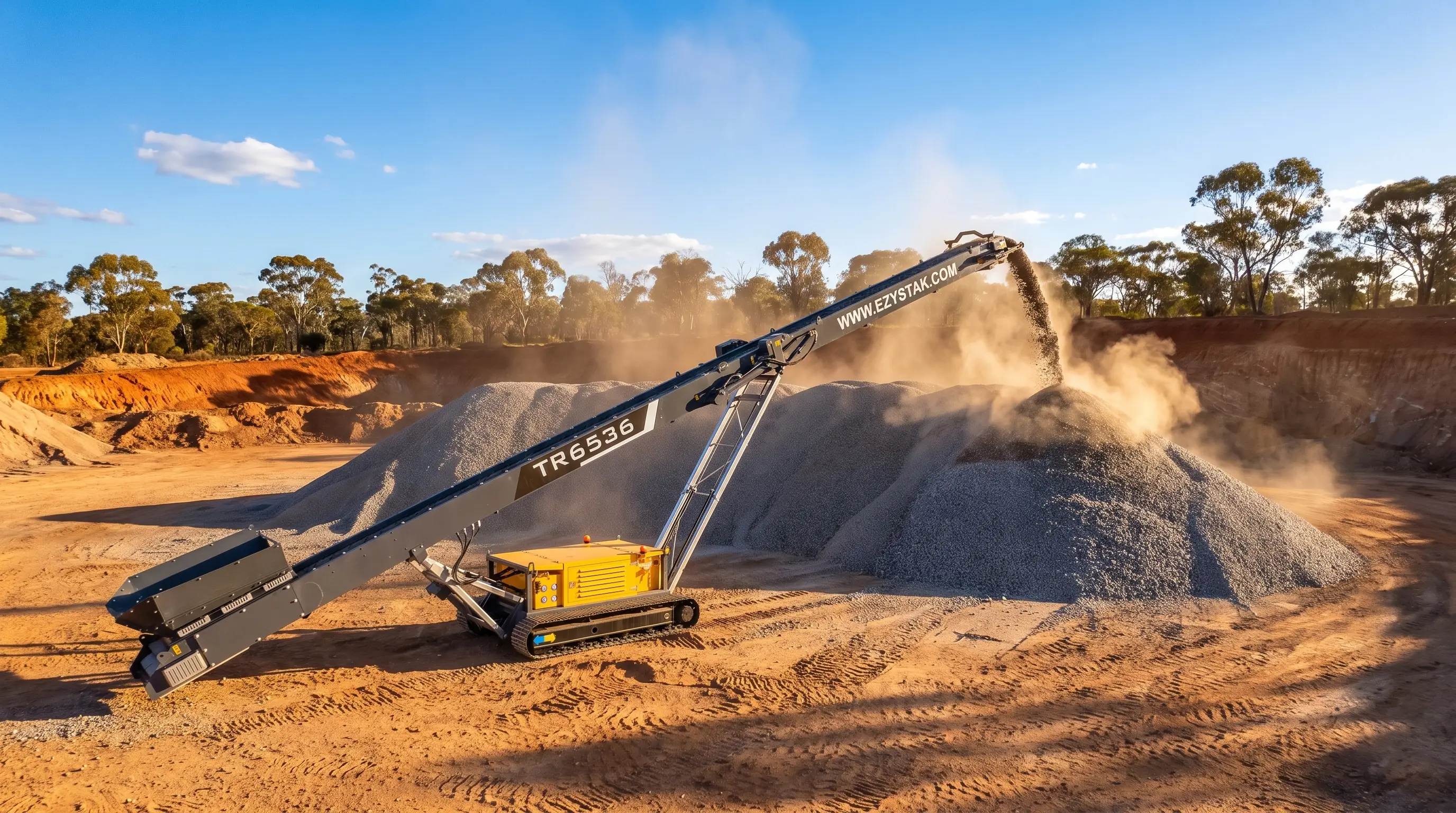
The case works because machines like the EZYSTAK R6536TR exist and are deliverable in Australia. It is a tracked radial stockpiler with a 65 ft, 36-inch belt, powered by a Cat 1.7 (37 kW) engine. At 9,000 kg it slews through a radial arc and raises or lowers hydraulically to lay down a large, kidney-shaped stockpile.
jawscrushers.com.au is the Australian dealer for Ezystak and Komplet conveyors, which means the spec sheets and on-the-ground examples behind this ROI case sit on its conveyors range, from the radial R6536TR through tracked units like the Komplet K-TC 460. The decision comes down to a single question: keep paying $150 an hour to shuttle product a few metres, or let a machine do it for 1 to 2 gallons and no operator at all.