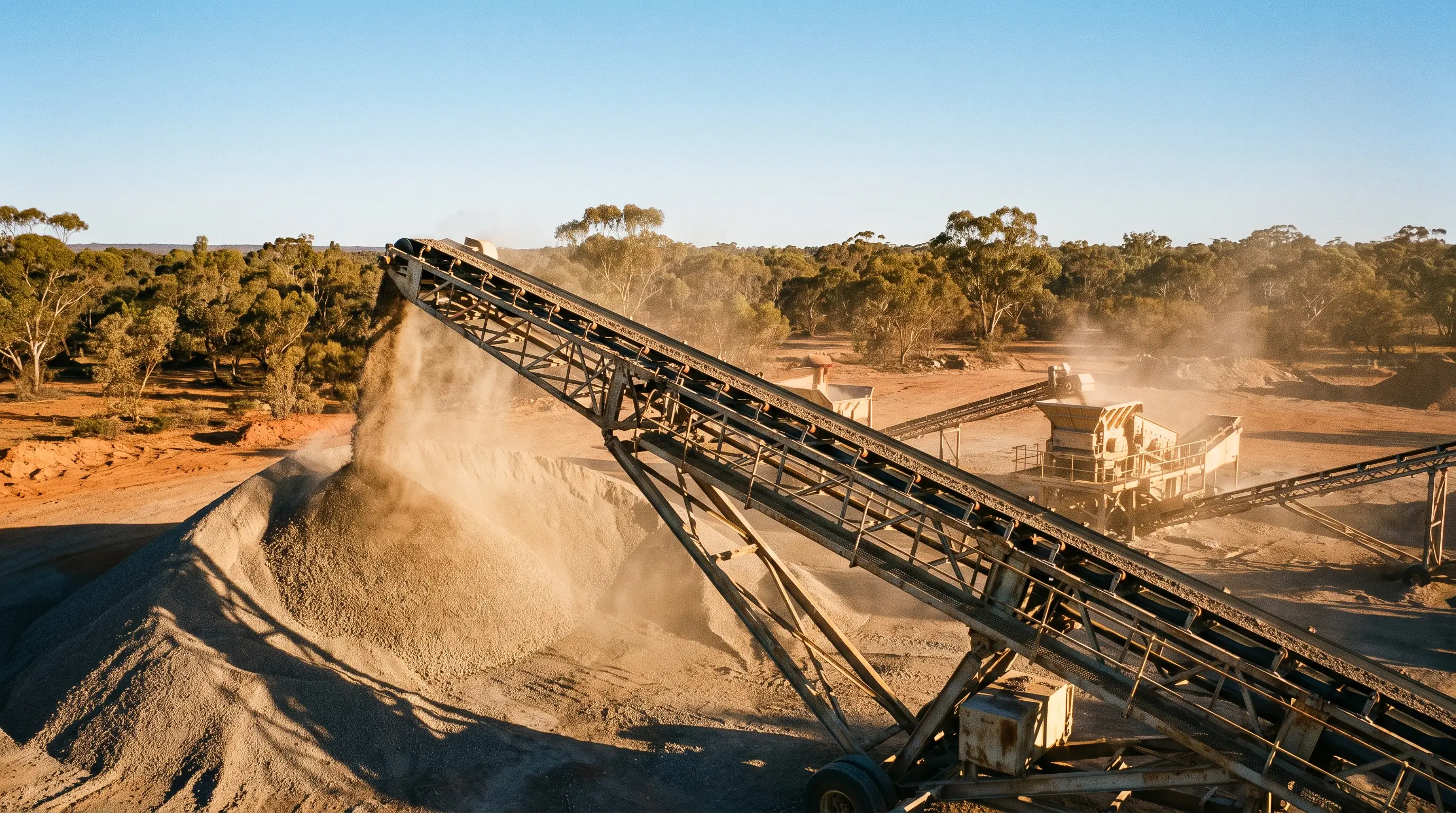
Your crusher is running flat out and your loader cannot keep up. Every few minutes the operator breaks off from feeding, drives over, and pushes the pile flat just to stop the cone from burying itself. That is the moment a radial stacker stops being a catalogue option and starts looking like the piece of gear that lets the circuit run at its rated output.
A radial stacker sits at the discharge end of a crusher or screener, takes the material, and lays down a wide, clean pile without anyone on the controls. The loader goes back to feeding and loading trucks. The crusher keeps crushing.
What a radial stacker does
A radial stacker conveyor is a belt conveyor built into an inclined rigid truss that rotates around a fixed pivot point at its tail. Material feeds in at the tail from a crusher, screener, or feed hopper, travels up the boom, and drops off the discharge head onto the stockpile. While it runs, the entire machine rotates through an arc, spreading material in a wide crescent rather than a single cone.
The arc a radial stacker sweeps depends on the model, ranging from 90 degrees to a full 360. The principle holds either way: one feed point, one machine, and a pile that holds multiple times more material than a fixed conveyor could build from that same spot.
The components are standard but built heavy. A fabricated truss carries the weight of the belt, the idlers, and a full load of aggregate. A motor and reducer mounted at the discharge head drive the belt. The slew ring or turntable in the undercarriage provides the radial rotation. Boom angle adjusts through a hydraulic system on larger units, a manual pulley on smaller ones.
When the pile reaches its maximum discharge height, up to 12 metres, the operator swings the boom a few degrees and starts building the next section of the arc. No moving the feed conveyor. No shutting down the crusher. No loader running circles around the pad. The conveyor belt keeps moving material while the machine rotates, typically 900 to 1,200 mm wide depending on the throughput required.
The point, in hours saved
The purpose of a stacker conveyor is simple: it builds the stockpile without the loader running all day. The loader operator’s job becomes feeding the hopper and loading out trucks, not racing between the discharge belt and a growing pile.
Automating the stockpiling process reduces the need for manual labour and minimises operating costs. In operations that would otherwise need a dedicated loader for the discharge area, radial stacking conveyors can eliminate the need for wheel loaders and trucks in stockpiling entirely.
Every hour a loader spends rehandling stockpile is an hour it is not feeding the plant or loading customer trucks. Multiply that across a week, a month, a 12-month contract, and the numbers explain why operators who switch to a radial stacker rarely go back. You stand on a site watching a loader push a cone into the ground while the crusher waits and you know the gear that fixes it.
Fixed, radial, and telescopic: which one is yours
Not every site needs a radial stacker. Some need a fixed stacker, some need a telescopic, and the choice turns on how your yard operates.
| Feature | Fixed Stacker | Radial Stacker | Telescopic Radial |
|---|---|---|---|
| Stockpile shape | Single cone | Wide arc, kidney-shaped | Layered arc |
| Capacity vs fixed | Baseline | 30 to 50 percent more | Highest capacity |
| Loader dependency | High | Low to none | None |
| Best for | Permanent single-material plants | Mobile crushing, quarries, demo sites | High-volume yards, ports |
A fixed stacker discharges at a single stationary point. It builds one cone, and once that cone reaches its maximum height, a loader has to push or rehandle material to make room. Fixed stackers cost less upfront and work in permanent installations where the feed location never changes.
A radial stacker rotates through an arc and builds a kidney-shaped pile that holds 30 to 50 percent more material on the same footprint. That margin matters on urban demolition sites, tight quarry pads, and anywhere space costs money.
A telescopic radial stacker adds an extending boom, allowing the discharge head to reach further from the feed point. This builds even larger layered piles and reduces the material segregation that happens when everything drops from the same point at the same height. For high-volume stockyards where capacity and product consistency both count, telescopic radial is the top of the stacker range.
For the form factor, there are three types to choose from: fixed radial (permanent installation), wheeled radial (towable, relocates quickly), and tracked radial (self-propelled, operates on soft ground where wheeled gear would bog). The EzyStak R6536TR stocked by jawscrushers.com.au is a tracked radial stockpiler, built to follow the crusher around a site and build piles on ground that was never graded. The Komplet K-TC 460 is another option in the range for lighter applications.
By the numbers
The specifications tell the story:
- Throughput: up to roughly 1,100 tonnes per hour
- Belt width: 900 to 1,200 mm
- Length: 15 to 45 metres and longer
- Discharge height: up to 12 metres above the pile
- Incline: up to 20 degrees
- Capacity gain over a fixed conveyor: 30 to 50 percent
- Stockpile volume from one feed point: 3 to 5 times that of a fixed conveyor
- Arc sweep: 90 to 360 degrees
Radial stackers can move material at high rates and discharge from elevated positions, depending on belt width and configuration. That throughput matches a serious crushing spread, and the machine does it without stopping to reposition.
Where stackers fit among conveyors
The four main types of aggregate conveyors are overland, stacking, transfer, and loading/unloading.
Overland conveyors are the long-haul machines: up to 2,100 mm wide, moving up to roughly 5,400 tonnes per hour over kilometres of terrain where trucks cannot run economically. They carry material from the quarry face to the processing plant.
Transfer conveyors handle direction and elevation changes where an overland conveyor’s turning radius is too large. Short, steep, and often portable, they bridge gaps in a circuit.
Loading and unloading conveyors are typically narrow, designed to fill railcars or barges or empty them into trucks and storage.
Stacking conveyors, the category radial stackers belong to, are typically 15 to 45 metres long. They lift material and let it waterfall off the end into a stockpile, and they are often radial in design, meaning they pivot or rotate. This is the shortest of the four main types, but the one that directly replaces loader work at the discharge end.
What to look for when buying or hiring
Radial stackers are custom-specified. Two sites rarely need the same machine, because TPH, material type, density, moisture, and yard layout all differ.
TPH determines belt width and speed. Your peak output from the crusher or screener feeding the stacker is the number that matters. Capacity and elevation together determine the minimum drive unit size. Material density and moisture affect belt specification, trough angle, and whether covers make sense. Dusty material in an urban quarry might need enclosed transfer points and dust suppression; clean, damp aggregate might not.
Portability is the next big choice. A tracked radial stacker handles soft, unpaved ground where wheeled units sink. A wheeled unit tows between positions quickly and suits operations where stockpile locations shift week to week. A fixed radial unit is for permanent stockyards with a stable feed point.
Construction type is a major cost lever. A fabricated truss frame handles longer spans and heavier loads than a channel-supported structure, which matters when you need the full 45 m of length and 12 m of discharge height.
For Australian crushing operators, the tracked radial stockpiler is the configuration that fits the way sites actually work: crushers that move as the stockpile area clears, ground that was never graded, and a loader fleet already stretched thin. jawscrushers.com.au stocks the EzyStak R6536TR tracked radial stockpiler and the Komplet K-TC 460 for lighter applications. When your crushing output outpaces what a loader can manage while also feeding and loading out, a tracked radial stacker turns a three-machine problem into a one-machine answer.
To see the full range, visit the conveyors page or talk to the team at jawscrushers.com.au about which stacker fits your output and yard.