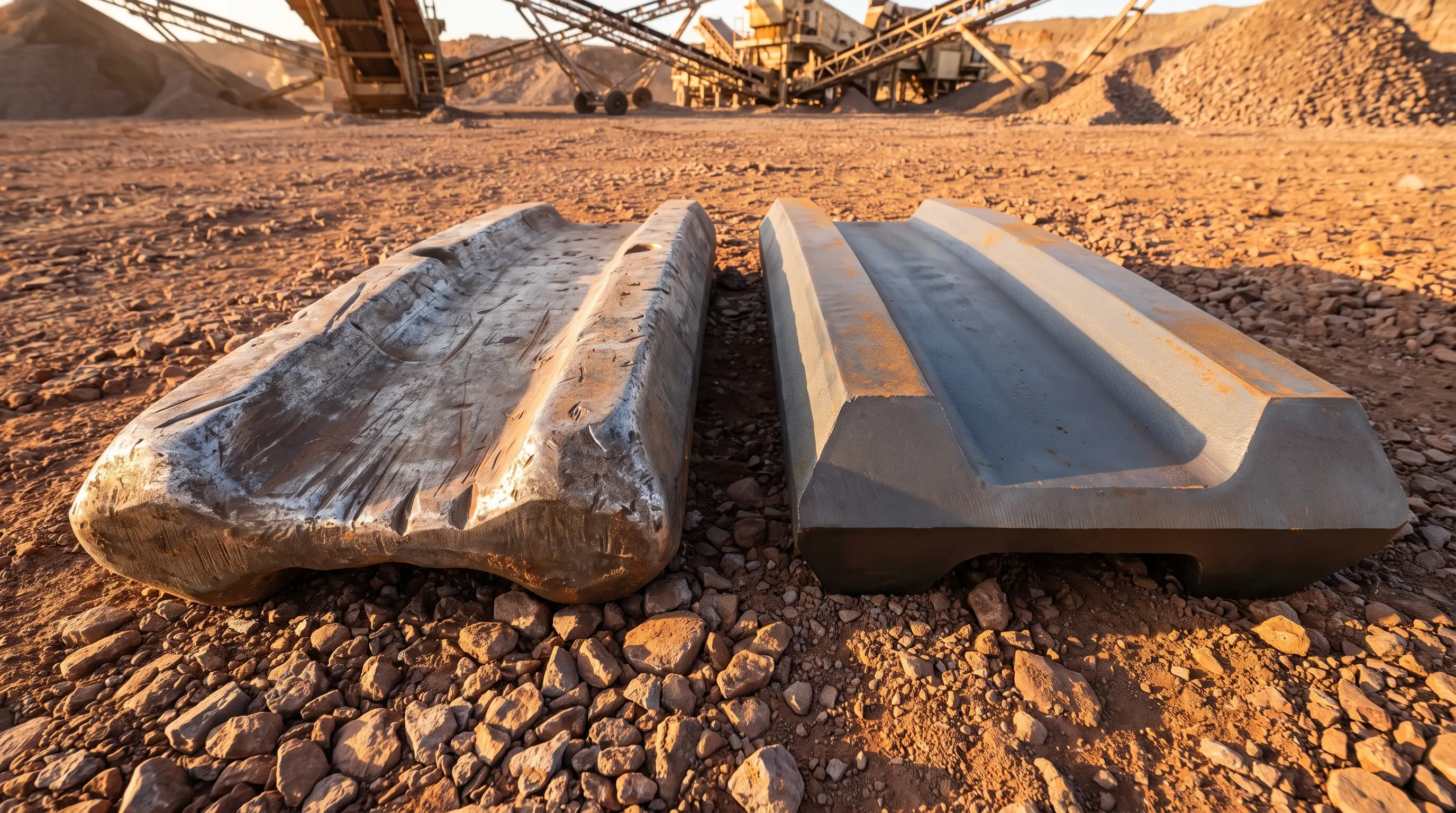
You get two quotes for a set of crusher wear parts and one looks like the decision. It isn’t. Wear parts are quoted per item but they’re paid for per tonne, and the cheaper set can quietly be the more expensive one once you count change-outs and lost output. On a compact mobile crusher the parts bill is small, so the real money is in keeping the machine crushing instead of dropping out mid-job for a fitter call.
Quick answer: cost per tonne is the set price divided by the tonnes that set crushed. Add change-out downtime and the output lost as liners wear, and a set costing 30% more per part can come out roughly 10% cheaper per tonne. Swap jaw dies when throughput drops more than 10-15%, product runs coarse, or power draw climbs 8-12%.
Unit price is the wrong number
Two quotations arrive and the only number both actually contain is the price per part. It’s also the number least connected to what those parts will cost you over a year.
The number that matters is cost per tonne. Cost per tonne = set price ÷ tonnes processed by that set. Two details matter: a complete set, not one part, and tonnes, not weeks. Calendar time hides how hard the plant actually ran.
Work the sums and unit price points the wrong way. A set that costs 30% more per part can be roughly 10% cheaper per tonne, because it crushes more tonnes before it’s done. On unit price alone you’d have chosen wrong. The best liner is the one that lowers total crushing cost, not the cheapest liner.
The three costs nobody logs
The per-part price leaves out three costs, and they’re usually bigger than the gap between two quotes.
Change-out downtime comes first. Every change is production hours lost plus labour, and blow bar and hammer changes are heavy, awkward work while the plant isn’t earning. A primary crusher offline for a liner replacement loses 8 to 24 production hours. Fold the change cost into the set price before dividing by tonnes, and a set that lasts 45% longer doesn’t just cost less per tonne, it removes whole shutdowns from the year.
Then there’s throughput and gradation decay, the cost almost nobody logs. A worn striking edge doesn’t just have less material left. It changes the crushing action: product gradation drifts and output rate declines before the part looks finished. On a spec-driven site you may be reprocessing or downgrading product while the parts are still nominally serviceable.
Third is the failure that takes something with it. A part that fractures rarely fails alone. A broken blow bar can damage the rotor, the impact aprons and whatever sits downstream. That cost doesn’t spread smoothly across tonnes. It arrives once and it’s large.
Put the three together: true cost per tonne = (set price + change-out cost + production lost to decay) ÷ tonnes processed. The decay term is the hardest to quantify and the one worth estimating even roughly, because leaving it at zero systematically favours whichever supplier is cheapest per part.
What wears, and the metal to match
Each crusher type wears different parts and wants a different metal.
| Crusher type | Parts that wear | Metal |
|---|---|---|
| Jaw | Fixed and moving jaw plates, cheek plates | Mn13 general, Mn18 for heavy primary impact |
| Cone | Mantle, concave (bowl liner) | Mn13 standard, higher Mn for coarse cavities |
| Impact | Blow bars, impact aprons, liner plates | Mn for impact, Cr-alloy or insert for abrasion |
On a jaw, the fixed and movable jaw plates form the crushing chamber where compression happens, the toggle plate is the safety mechanism, and the pitman and eccentric shaft drive the movement.
The workhorse metal is Hadfield manganese steel, first patented by Robert Hadfield in 1882. It’s soft and tough when cast, roughly 200 HB, but work-hardens dramatically at the surface under repeated impact, reaching 500 HB or more while the core stays tough. You buy it soft: the more you hit it, the harder the working face gets.
Standard Mn13, about 13 percent manganese, suits most crushing. Mn18 handles high-impact primary duty. Chromium-alloyed grades resist abrasion where impact is low. For cone liners, Mn18Cr2 is the common choice for granite, basalt and hard quarry aggregate, while Mn22Cr2 is reserved for very hard ore and severe impact.
Five signals it’s time to swap
Wear is gradual, so the machine tells you in the numbers before it fails in the field. Five signals matter most.
| Signal | The number | What it means |
|---|---|---|
| Throughput drop | More than 10-15% below baseline | Chamber geometry has worn past its optimal range |
| Coarser product | More oversize, off target gradation | Worn liners are a primary suspect |
| Power draw up | Sustained 8-12% or more | Machine is working harder per tonne |
| Life remaining | Less than 20% anywhere on the face | Time to change or rotate the liner |
| Uneven wear | Swing vs fixed drifting apart | Rotate 2 fixed for every 3 swing liners |
A throughput decline of more than 10-15% against baseline is a strong indicator the chamber geometry has worn beyond its optimal range. Worn liners shift the product coarser and less consistent, and if your screens are seeing more oversize, worn liners are a primary suspect. A sustained power draw increase of 8-12% or more, not a momentary spike from a big boulder, means the wear part is due.
On jaws specifically, change or rotate a liner when less than 20% of life remains anywhere along the working face. Swing and fixed jaw liners wear at different rates, so the typical rotation is 2 fixed liners for every 3 swing liners.
Track tonnes, not calendar time
Liner life is measured in tonnes crushed per set, not calendar time. Two machines on the same job can chew liners on completely different clocks.
Silica content is the single biggest predictor of wear. Quartz-rich granite, basalt and river gravel eat liners far faster than limestone, and trickle or one-sided feeding concentrates wear in a band and can halve liner life.
At every change-out, write down the tonnes processed since the last change, the hours down and how many people worked on it, the output rate at the start of the set and just before the change, and which failure mode ended the set. After two or three cycles that log turns every quote into a technical discussion instead of a price negotiation.
A fair trial between suppliers needs three things: change the full set, not a few positions; run it on comparable feed; and record tonnes, not weeks, photographing the parts as they come out. A trial run casually produces an opinion that gets argued about for a year.
What run-to-failure costs in Australia
On a compact mobile crusher in Australia, wear parts on jaws, liners and belts run $500 to $1,000 per week. That’s the predictable number. The expensive one shows up when you run parts too long.
Planned replacement takes 2 to 4 hours of scheduled downtime with parts in stock. Unplanned failure can take 12 to 48 hours to recover from, with emergency parts freight on top. An unplanned stoppage can cost $5,000 to $50,000 per hour once lost output, idle labour, freight and contract penalties stack up. Wear parts run too long or fitted badly account for an estimated 25 to 35% of unplanned downtime events.
Put the machine itself in perspective. A mini jaw crusher sits well under A$100,000. A compact tracked jaw runs into the low-to-mid hundreds of thousands. A fully specced compact impactor can push past A$1 million landed. Impactors cost more because they have more moving parts, but in exchange they produce finished aggregate, while a jaw produces a 3-6 inch non-compactable material for backfill or further processing.
That’s the economics behind every wear-part order at jawscrushers.com.au: the parts bill is small next to the machine, so the win is keeping it crushing rather than paying a fitter to get it running again. Their crusher range ships with parts and in-field service behind it, which is what makes a cost-per-tonne number you can actually hold. $500 to $1,000 a week is the number you plan around; $5,000 to $50,000 an hour is the number you’re trading against when a liner runs past its signal.